March 2, 2026
“Instead of just grinding, I was more of an explorer. I’d go around and see every corner of the map.”
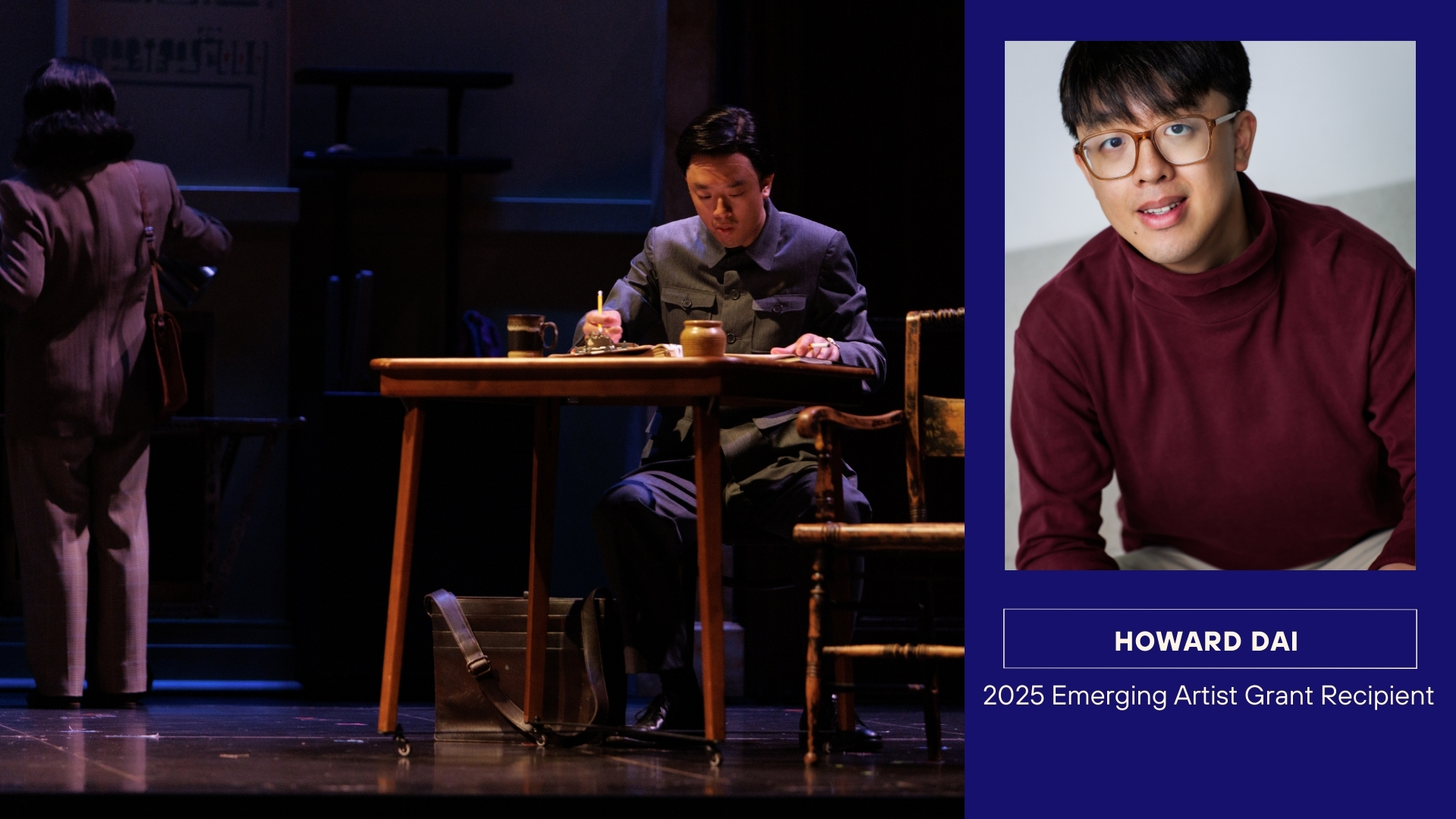
This is theatre maker Howard Dai, answering a question about playing video games as a kid. But it’s hard not to see a connection to the way he spends his time these days, now that he’s the ripe old age of twenty-nine. Dai’s work covers a lot of ground. He has devised multi-lingual works that incorporate augmented reality, while in digital residence at places like Impulse Theatre’s PeekFest, Rumble Theatre, The PuSh Festival, and the UK’s Royal Court, and made audio-plays for children based on Chinese holidays, as a member of the Five Blessings Collective. He’s acted in the world premiere of Salesman in China at the Stratford Festival, trained in performance capture, and takes gigs as a sound designer, technical director, and interactive programmer, all while pursuing his own unclassifiable creations, in and around Vancouver’s renowned indie performance creation scene.
And Dai isn’t done exploring. With a portion of his Emerging Artist Grant from the Siminovitch Foundation, he bought a laptop with enough capacity for cutting edge projection design software. In his off-hours, he’s been taking YouTube tutorials and making little projects, with an eye to incorporating the technique into his own work, and also, as he puts it, “to lend my skills to theatre companies to make some fun things.” To him, what’s interesting is the interactive part. He loves the idea of “an audience member reacting to audio, interacting with art work, doing things with it, seeing the cause and effect in real time.”
For someone so keen on technology, Dai’s interest in live theatre might be surprising, at first glance. “I don’t really watch film or TV,” he says, “I never was into it. For some reason I never really quite enjoyed the idea of sitting at home and putting on a movie. It always felt like I could go out and do something more useful.”
It all seems to come back to this idea of interactivity. Dai points out that all theatrical events, even conventional plays, are defined by the fact that the audience is in the same space as the performance, and it’s obvious that he likes that relationship to be lively. “My pet peeve for shows,” he says, “is when it feels like I don’t need to be there.” In his view, tech isn’t a passive, one-way delivery mechanism, like when you’re lying on the couch at home, flipping through a carousel of options on a streaming platform. Quite the opposite. Dai thinks the inventive use of tech can act as an invitation to the audience to get in there and play. “I make interactive work so the audience can feel like they have a hand in whatever it is they are experiencing,” he says. Even when the show’s over, Dai relishes theatre’s vibe: “You’re with people right away, you can share this energy together. Whether it was good or bad, you’re in community.”
Born in Canada, Dai lived in Taipei from the ages of five to twelve. When he came back to Vancouver with his mother, as a teen, the drama and band rooms were his refuge, “not because I’m good at music, but because of what it made me feel.” In grade eight, he was on the student stage-crew for Grease. On closing night, a teacher, clearly picking up on some sort of yearning in him, took him into the dressing room, found him a costume, and invited him to go onstage for the finale. Dai says that looking back, there had always been a performer in him, but that experience cemented his place in the community of theatre: “If you’re so lucky to find the people you can be with,” he says, “stick with it.”
Dai calls his time at Simon Fraser University’s BFA in Theatre and Performance program “devising school,” an inspiring, challenging place where and his fellow students were given materials, parametres, and a deadline, and had to make something, every single week. Nowadays, studio time is precious, especially in expensive Vancouver, so Dai finds he spends quite a lot of time behind a laptop, working on logistics. But he’s fine with that. “I really love spreadsheets,” he says. “I think I’m really good with them, I think spreadsheets are integral to my process. So by the time I’m in the studio, I’m ready to make things.” He brings along what he calls his “devising kit,” a couple of tote bags full of things like fishing line, bungee cords, scraps of fabric, and many kinds of tape. Useful items to have on hand, he’s found, when you need to rig something up quickly.
His current project is inspired by the flamboyance and excitement of the televised lottery draws he remembers from his childhood in Taiwan. Called Dream Machine, it’s a large-scale, interactive installation piece that gamifies the dreams and aspirations of the audience. He’s captivated by the image of the numbered balls, bouncing around in the drum, each one a possibility, a piece of someone’s hypothetical future. “One of the first things I tried to do was get a lot of ping pong balls in the studio,” he recalls. “What can we make with them?” Since then, the piece has evolved through several labs and workshops with Rumble Theatre and rice & beans theatre, where Dai is an Associate Artist. “Whenever I do Dream Machine,” he says, “it feels like me practicing to host a birthday party.” He anticipates one more workshop before the end of 2026, then the piece will be ready for production.
His Siminovitch mentor, 2025 Finalist Adrienne Wong, is offering support during their monthly standing meetings. Their connection goes back to when he was a teenager. She “really inspired my pursuit of making theatre with technology,” he says. As for this piece, she continues to help him with “pushing the boundaries beyond what is conventional in form. Every time I make a new work,” he explains, “I feel like I’m exploring a new dramaturgy.”
For now, it’s more time on his laptop, at home in the apartment he shares with his mom. The street they live on is quiet compared to Taipei, a place of “overwhelming stimuli, which I love,” he says. But his mother’s TV is usually on in the background while he works, and “that’s the sound that makes me feel like home.”
Howard Dai is a Taiwanese actor, writer, director, and theatre artist based on the unceded land belonging to the xʷməθkʷəy̓əm, Skxwú7mesh, and səl̓ilwətaɁɬ Nations, colonially known as Vancouver. He was selected by 2025 Siminovitch Prize Finalist Adrienne Wong to be one of the 2025 recipients of the Siminovitch Foundation’s Emerging Artist Grant. https://howarddai.com/
Listen to Five Blessings’ audio-plays for kids here!
Howard Dai was selected as Siminovitch Theatre Foundation Protégé by 2025 Finalist Adrienne Wong.
Vanessa Porteous is a theatre artist, filmmaker, and writer based in Calgary. From 2018 to 2021 she was Jury Chair for the Siminovitch Theatre Foundation prize.
Photo: Salesman in China (2024) – dir. Jovanni Sy at Stratford Festival – photo by David Hou