
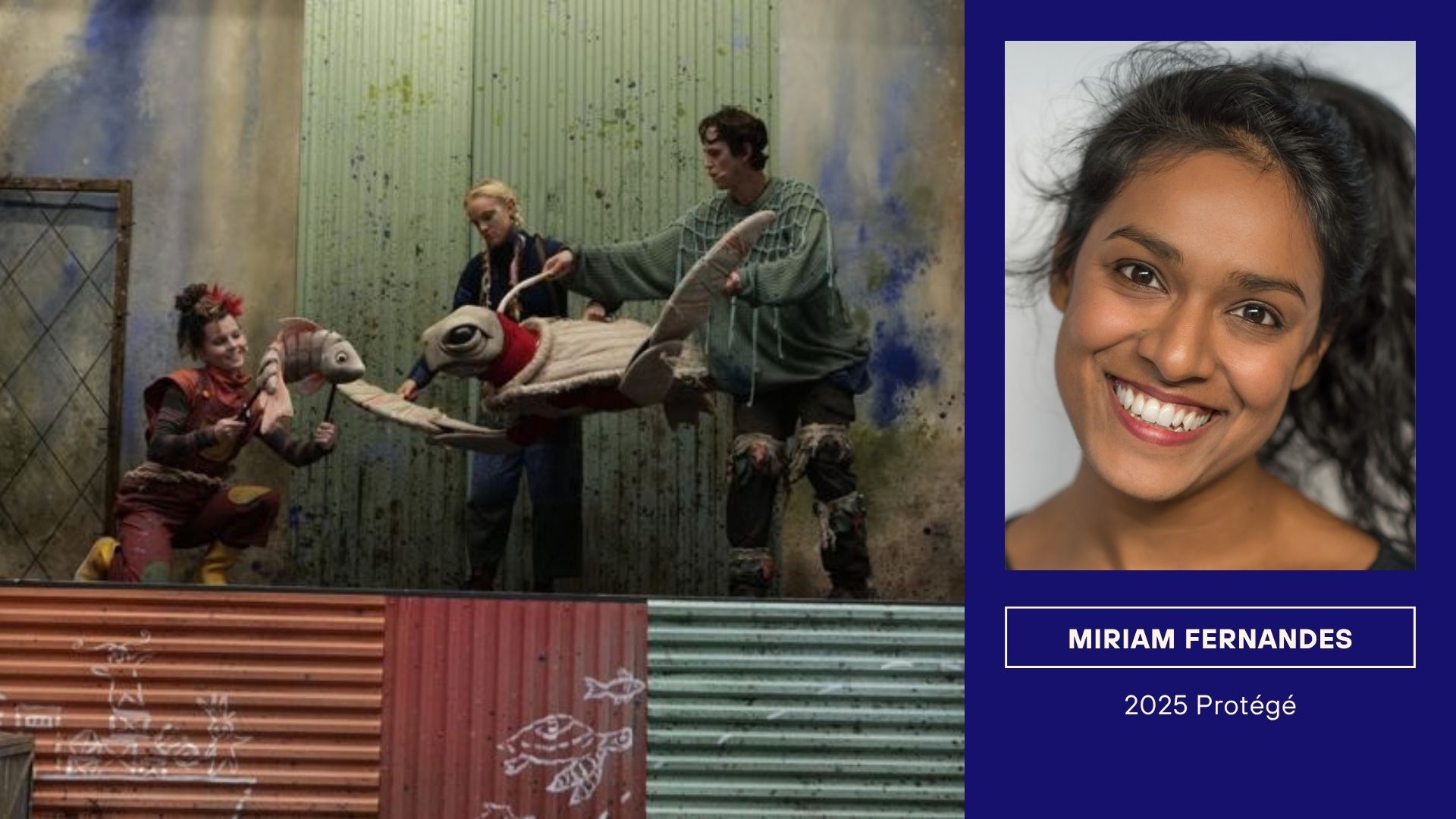
“I’m in the tempest of a two-year-old,” says Miriam Fernandes, laughing about living with a toddler. “I’m trying to adjust to life as an artist with a tempestuous being around, who also brings tons of joy and love…”
Fernandes juggles many roles: mother, creator, director, performer, and co-Artistic Director of Why Not Theatre, where she works with Siminovitch Prize Laureate Ravi Jain, who selected her as the Protégé for 2025. Amidst this joyous tempest, she says being part of the Siminovitch community has brought her some inner calm and confidence, a sense that “I don’t need to keep looking to other people.” The honour was also a welcome acknowledgement of her multifarious contributions, as she shifts away from acting to focus on directing.
Born and raised in Toronto, Fernandes has always been an artist who “straddles borders and doesn’t just do one thing.” After studying at York University, she trained with SITI theatre in New York, then enrolled in the renowned Ecole Internationale Jacques Lecoq in France. She credits Lecoq with introducing her to a holistic vision of the artist, quoting him as saying: “’I want my students to be rigourous theatre creators, and avid livers of life.” His training inspires her to this day. “Lecoq was interested in the poetry of the body,” she explains, “That unlocked how I work as a director and creator, helped me tap into something that was beyond my logical left brain thinking.”
That early experience also whetted her appetite for theatre that leapfrogs language and culture. Working outside your mother tongue awakens new sensibilities, she explains, letting you dive beneath the surface of the text. “There’s rhythm, emotional dynamics, character dynamics… [As a director,] It allows me to find the real motor of the play in a more visceral way.”
She recounts an inspiring example, during a workshop reading of An Enemy of the People by Norway’s Henrik Ibsen, at Bergen’s Den Nationale Scene, where she maintains an ongoing directorial role. When the scripts were handed out around the table, she was surprised to discover the original was written in Danish, not Norwegian – or rather Dano-Norwegian, a hybrid dialect that grew out of Denmark’s centuries-long cultural influence over Norway. “At that point, I could get by in Norwegian, but my Danish was nothing,” she explains. Still, the actors could read Danish, so they decided to go ahead. “It unlocked a completely different dynamic, and a humour that was really true to the play. All the Norwegians around the table were laughing so hard, and I was like, whoa, I had no idea Ibsen was so funny. I was listening with a different ear. I was listening with my whole body.”
Working multi-lingually remains a throughline in Fernandes’ work. During a recent exploration of writing by Korea’s Han Kang, the character of the husband elicited strong negative reactions from the non-Korean female actors in the room, but the two Korean actors felt the translation didn’t do justice to the original. So Fernandes asked them to improvise a scene in Korean. “Their entire bodies changed,” she recalls. “We were all feeling for these two people in a complicated relationship. And it was amazing to see that immediately unlock, when these two people played in another language, and none of us spoke Korean.”
Fernandes’ fascination with the drama to be found at the crossroads of language, body, and story, sustained her throughout the roughly ten years she, Ravi Jain, and their numerous collaborators worked on their stage adaptation of The Mahabarata, an epic of ancient India, and considered one of the longest poems ever written. “Covid really prolonged the journey,” she recalls, “in a very helpful way actually, for the work, but in a painful way, while we were in it.”
The acclaimed two-part theatrical work that resulted incorporates numerous musical styles, multiple languages, many forms of dance, and storytelling techniques that range from puppetry to video. It premiered at the Shaw Festival in Niagara-on-the-Lake in 2023, and went on to runs in Toronto, Perth, and the Barbican in London, before closing in 2025 at the Lincoln Centre in New York. As usual, Fernandes played many roles. She was co-writer, performed the character of The Storyteller, and continued her gig at producing company Why Not Theatre, where, she jokes, she has done almost every job at least once.
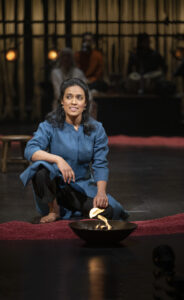
“I found a kind of solace in the last couple of years of writing Mahabarata,” she remembers. “The world changed so much, but the story stayed the same. It was a fixed point.” Spending so many years on one sprawling, ancient narrative, then sharing it, night after night, with so many diverse audiences around the world, showed her how urgent the immemorial questions of the piece remain today. How do we release our hatreds, our anger, our urge for revenge, it asks. How, together, will we truly find peace?
Fernandes seeks out that universality in every project. For her, it is at the centre of the theatrical act: to bring people together, through and over and across difference, in our increasingly divided time. Theatre, she says, is “a disruption of the imagination. It changes what you think is possible in the world.”
Now that Mahabarata is over, she, Jain, and Why Not Theatre are asking themselves what stories are needed next, to “heal our times and inspire us to actually shift the way we’re living.” “We’re back in the empty space,” as she puts it, quoting legendary theatre maker Peter Brook.
In fact, space in the literal sense is one of their hot topics, in an industry where ballooning costs can dampen artistic risk and quash institutional support for the next generation of creators. “We’ve outpriced ourselves,” she says. “We’re theatre-makers who can’t afford to make theatre in the buildings we run.” So they’re taking some time, over at Why Not, to contemplate new directions, not only in their own programming, but for the sector as a whole.
Time is another rare commodity in our conventional theatre model, we agree, with its long hours, rare days off, and a production process often plagued by stress and haste. “We’ve lost so many people over the past five, six years, coming out of Covid,” Fernandes points out. She can’t help comparing it to Bergen, where rehearsal days are shorter, maternity leave is a given, and everyone gets a summer holiday. But it’s about more than just working conditions, she explains. It’s about a more holistic approach to life. “That place smells like the sea,” she says. “You can’t help but be in relationship to nature… [you’re] reminded that the stories you’re telling are one thread of a huge tapestry of stories that these mountains and trees have witnessed.”
Meanwhile, back at home, Fernandes is embracing this time of reflection and search, an important, often-neglected part of the creative cycle. “I’m in a season of planting seeds,” she says. “And you don’t know which seeds will grow, and which seeds will flop. I’m excited, to just be in that place.”